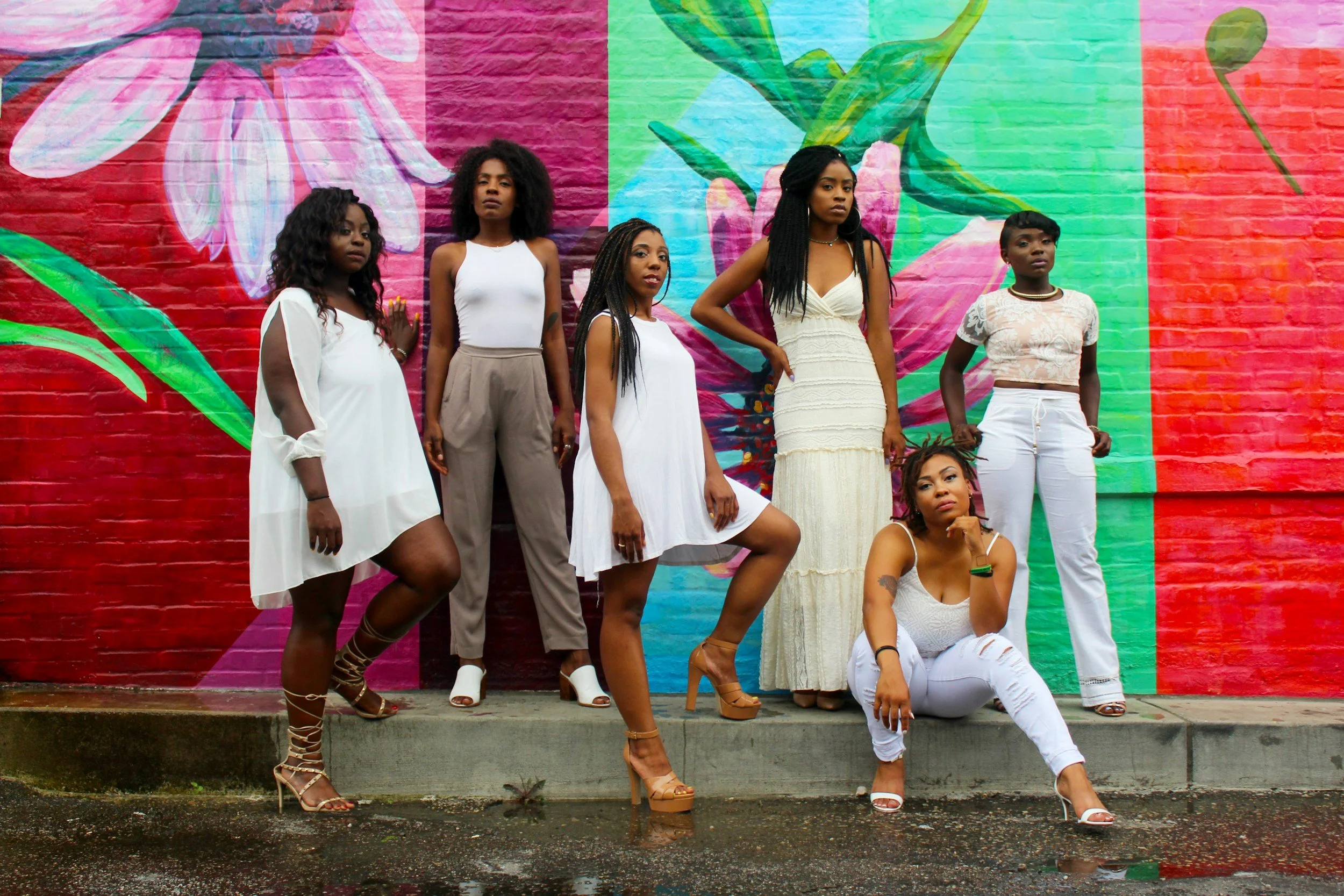
There's a certain discomfort that comes from talking about colourism within pretty much every space and setting that exists within Black communities. The issue is that, without naming it, the barriers and challenges that present themselves because of its existence remain. The argument from many who benefit from colourism, particularly in professional and business settings but also in creative settings, is that they work hard and thus that hard work over rides any of the benefits that they receive from their privilege (privilege that they often do not wish to address of discuss). Of course, hard work will always initiate any kind of progress, but, as we know, or at least I hope you know, hard work is never enough. There will continue to be systems which are geared towards maintaining the status quo, regardless of how hard we work.
As a dark-skinned Black woman, I have worked hard. Perhaps at times I have felt the need to work too hard to accomplish the things that I have accomplished. However, I've also been met with resistance and disrespect. I've been expected to be resilient and strong when others are given the space to be more vulnerable. The times when I've been "tough" have been labelled as aggressive, when others have been labelled as assertive. This goes beyond the usual racialised structures that I have navigated professionally. It also exists within our own communities, through the colourism that I have mentioned.
So, does entrepreneurship have a colourism and desirability problem, particularly when it comes to Black women?
I think it does ad while I appreciate that this might be an uncomfortable conversation for some, I believe it is one we need to have more openly. We often talk about the barriers Black women face in business. We discuss access to funding, the gender pay gap, racial inequality, underrepresentation, networking opportunities and the challenges of building businesses in environments where we are not always represented or understood.
But there is another dimension that I don't think receives enough attention: the extent to which complexion, perceived attractiveness and desirability can influence how Black women entrepreneurs are perceived, received and positioned within the business landscape. It is a conversation about colourism, but it is also a conversation about visibility, opportunity, influence and the unspoken expectations placed on women who want to be taken seriously in business. Having spent many years self-employed and building my own business, these are things I have observed. They are not necessarily things I have always felt comfortable discussing because of the risk of backlash but I think pretending they don't exist does little to advance the conversation about equality in entrepreneurship. The question isn't whether every opportunity someone else receives should have been yours. It is whether we are honest about the factors that influence who gets seen, who gets invited into certain rooms and who is perceived as someone worth investing in.
Colourism in entrepreneurship: Is complexion influencing who gets the opportunities?
Colourism is not a new phenomenon. It refers to the preferential treatment or discrimination people can experience based on their skin tone, often within the same racial or ethnic group. It can manifest in social relationships, popular culture, media representation, employment and other areas of everyday life. But what does colourism look like in entrepreneurship? I think it is worth examining how different Black women are positioned within business environments, particularly when it comes to speaking opportunities, professional visibility, media representation, industry recognition and access to influential networks.
I have observed situations where lighter-skinned and Black women and mixed race (white and Black) appear to be more readily positioned for certain opportunities, particularly those involving public representation, speaking on panels, being featured in business conversations or becoming the visible face of particular initiatives. To be clear, I am not suggesting that these women are undeserving of those opportunities. Black women and Mixed race Black women deserve to occupy spaces of influence, irrespective of their complexion. Nor am I suggesting that every decision to invite someone to speak, collaborate or represent an organisation is motivated by colourism. There are undoubtedly and objectively people who have more experience, greater expertise or a stronger track record in a particular area. That is perfectly reasonable.
But it is also possible for more than one thing to be true. Someone can be qualified for an opportunity while the wider environment in which opportunities are distributed still reflects unconscious preferences and biases and that is where I think we need to be willing to have a more nuanced conversation. If we are serious about understanding inequality in entrepreneurship, we cannot only examine race and gender in isolation. We also need to consider how complexion and other perceptions of desirability might influence the way Black women are received.
The relationship between colourism, visibility and professional opportunity
Visibility is often discussed as an essential component of building a successful business or personal brand. Entrepreneurs are encouraged to put themselves out there, develop their profiles, speak at events, build relationships, share their expertise and become recognised within their industries and rightly so. Being visible can create opportunities. It can help establish credibility, attract clients, develop partnerships and position someone as an authority in their field. However there is an important question we don't always ask: are all Black women afforded the same opportunities to become visible?
There is a difference between telling someone to become more visible and examining the conditions that determine whose visibility is encouraged, supported and amplified. Who gets invited to speak at industry events? Who is approached for media commentary? Who becomes the face of a campaign? Who is repeatedly featured in conversations about entrepreneurship, leadership and business success? And perhaps just as importantly, who gets overlooked?
If the same types of women are consistently being positioned as representatives of Black female entrepreneurship, we should be prepared to examine why. This isn't about taking opportunities away from one group of women to give them to another. It is about questioning whether the criteria we use to identify talent, credibility and professional suitability are as objective as we might like to believe. We need to consider whether unconscious preferences around complexion, appearance and perceived attractiveness are influencing who is considered suitable for particular spaces. Visibility is not distributed in a vacuum, it’s influenced by relationships, networks, gatekeepers, cultural expectations and, potentially, biases that are not always acknowledged.
The desirability factor: Does being attractive influence how women are received in business?
This is where the conversation becomes even more interesting. Desirability is a complicated subject, particularly when we bring gender, race and appearance into the discussion. In business, we like to believe that people are evaluated primarily on their expertise, experience, commercial ability and the value they bring but human beings do not operate entirely free from perception. It almost goes without saying that appearance can influence first impressions and societal ideas about attractiveness can shape how people respond to others, sometimes without even realising it.
For women in business, these expectations can be particularly pronounced. A male entrepreneur can often turn up in jeans and a t-shirt, establish himself through his knowledge and experience and be judged largely on the substance of what he brings to the table and his charm or personality. Now of course, men also face expectations around grooming and professional presentation but women can face an additional layer of scrutiny around how they look, how they dress, how they present themselves and whether their appearance fits an often unspoken standard of professional desirability.
There is an expectation to look polished, confident, approachable and presentable. While I’m not going to deny that I believe in presenting yourself in a way that reflects how you want to be received, we should not pretend that appearance has no bearing on how women are treated.The issue becomes more complicated when we consider how conventional beauty standards intersect with race and skin tone. Whose appearance is considered polished? Whose image is considered aspirational? Who is viewed as commercially attractive? Why are we still having conversations about hair in the 21st century? Who fits the aesthetic preferences of brands, event organisers, media platforms and potential collaborators? These are not necessarily questions people will openly acknowledge when making decisions but that does not mean they are not worth examining.
There is already a wider conversation about the barriers Black women face when accessing entrepreneurial finance and scaling. Research and industry reporting, particularly from the United States, have highlighted persistent disparities in venture capital and other forms of business funding for women and founders from underrepresented racial groups. The UK has its own distinct challenges around access to capital, networks, representation and business support.
However, I think there is another question worth exploring.
When we examine the different experiences of Black women entrepreneurs, are we paying enough attention to differences within that group? Black women are not a homogenous category. We have different experiences, backgrounds, educational opportunities, networks, resources and routes into entrepreneurship. And complexion may be another factor worth considering. If we already recognise that race and gender can influence how entrepreneurs access opportunities, why would we automatically assume that skin tone has no bearing on how those same entrepreneurs are perceived?
I would like to see more research exploring this, particularly within the UK entrepreneurial ecosystem. How are Black women of different skin tones represented at business events? Who receives invitations to speak, participate in industry initiatives and represent entrepreneurial communities? Are there differences in media visibility? How do perceptions of attractiveness influence networking, professional relationships and commercial opportunities?
These are questions that deserve more than anecdotal discussion.
I recognise that my own observations do not constitute a comprehensive body of evidence but lived experience can raise important questions that research should investigate. Sometimes, the first step towards understanding a problem is being prepared to acknowledge that it might exist.
The pressure on Black women to package themselves for business
There is another dimension to this conversation that I think deserves attention: the pressure on Black women entrepreneurs to package themselves in particular ways.
Personal branding is important, I have spent a significant part of my professional life working around PR, reputation and positioning, so I am certainly not suggesting that presentation is irrelevant. How you communicate, how you show up and how consistently you present your expertise all contribute to the way people understand your professional identity.
I often say that you should show up in a way that reflects how you want to be received. That doesn't mean pretending to be someone you are not. It means understanding that your presentation is part of the story you communicate about yourself and your business.
However, there is a difference between choosing to present yourself professionally and feeling compelled to conform to a narrow standard of desirability to be taken seriously. For Black women, that pressure can intersect with expectations around hair, clothing, body image, skin tone, femininity and perceived respectability. There can be an unspoken expectation to be polished without appearing overly concerned with appearance, confident without being perceived as intimidating, attractive without being considered distracting, and assertive without being labelled difficult.
It is a complicated balancing act and when we add colourism to the equation, we have to consider whether certain Black women are afforded greater acceptance because their appearance more closely aligns with dominant beauty ideals. Again this is not about suggesting that presentation does not matter. It is about questioning why the standard of presentation, and the way it is interpreted, might not be applied equally.
Why we need to talk about colourism within Black business spaces
One of the reasons I think this conversation is important is that we sometimes focus so heavily on the external barriers facing Black entrepreneurs that we are reluctant to examine the dynamics that might exist within our own communities and professional networks. We can talk about racism in wider business environments. We can talk about gender inequality. We can talk about the lack of funding and representation. When all is said and done are we equally comfortable discussing colourism?
It can be difficult because conversations about skin tone and desirability can quickly become personal. People may feel accused whilst others may interpret the conversation as jealousy, resentment or an attempt to undermine women who have achieved success.
That is not what this is about.
Black women who are successful, visible and influential should be celebrated. Their achievements should not be questioned simply because they receive opportunities or have a particular complexion. But celebrating individual success should not prevent us from examining the systems and preferences that shape whose success is recognised and amplified. We need to be able to hold two ideas at the same time: Black women deserve to succeed and the environments in which we pursue success may not treat all Black women equally.
That is not an attack on individuals. It is an invitation to examine the structures, assumptions and behaviours that influence opportunity. If we cannot have those conversations within Black business communities, where can we have them?
If we want a more equitable entrepreneurial landscape, we need to move beyond simply encouraging more Black women to start businesses, become visible and build personal brands. We also need to examine the environments in which those women are expected to operate.
So what can we do to drive change? There are several areas worth considering.
1. Be more intentional about representation
Event organisers, media platforms, business networks and organisations need to think more carefully about who they invite into conversations about Black entrepreneurship. Representation should reflect the diversity of Black women, rather than repeatedly drawing from a narrow pool of familiar faces.
2. Examine how opportunities are distributed
Who gets invited to speak? Who receives introductions? Who is approached for collaborations? Who gets access to influential networks? Organisations should consider whether their selection processes are genuinely inclusive and whether unconscious preferences might be influencing decisions.
3. Challenge narrow ideas of professional desirability
Expertise, experience, credibility and commercial value should not be secondary to whether someone fits a particular aesthetic. Professional presentation is one thing. Expecting women to conform to narrow beauty standards to be considered credible is another.
4. Create more space for honest conversations
We need to become more comfortable discussing colourism, including within Black professional and entrepreneurial communities. That means listening to experiences that might be uncomfortable, resisting the urge to become immediately defensive and being prepared to examine our own assumptions.
5. Invest in evidence and research
Anecdotal observations can highlight potential patterns, but we need more robust research examining the relationship between complexion, perceived attractiveness and entrepreneurial opportunity. This is particularly important in the UK, where more specific research into the experiences of Black women entrepreneurs could help develop a clearer understanding of the issue.
Ultimately, I don't think we should dismiss the possibility that colourism and desirability influence how Black women entrepreneurs are perceived and received.
I am not suggesting that every professional opportunity is determined by appearance, that every lighter-skinned woman has an advantage, or that darker-skinned women cannot build successful, visible and influential businesses. That would be an oversimplification. What I am suggesting is that we need to be more honest about the possibility that complexion and perceived attractiveness form part of the wider set of biases influencing professional recognition and opportunity. We spend a lot of time talking about how Black women can position themselves better, become more visible, build stronger personal brands and establish authority. We also need to spend more time examining the environments in which that visibility is rewarded. If we continuously tell Black women to work on their positioning without questioning whether they are being received equally in the first place, we risk placing the entire responsibility for unequal outcomes on the individual.
Black women should be able to build businesses, establish reputations, access opportunities and become influential without feeling that their complexion or their proximity to conventional beauty standards determines how seriously they are taken.
This isn’t about competition between Black women or hating on each other. It is about recognising that professional opportunity is shaped by more than talent and hard work and I think that is a conversation worth having.